
Several businesses we work with have received domain renewal notices that look completely official. They use the business’s real name, address, website and email, all taken from public records, and ask for around $186 by card within seven days.
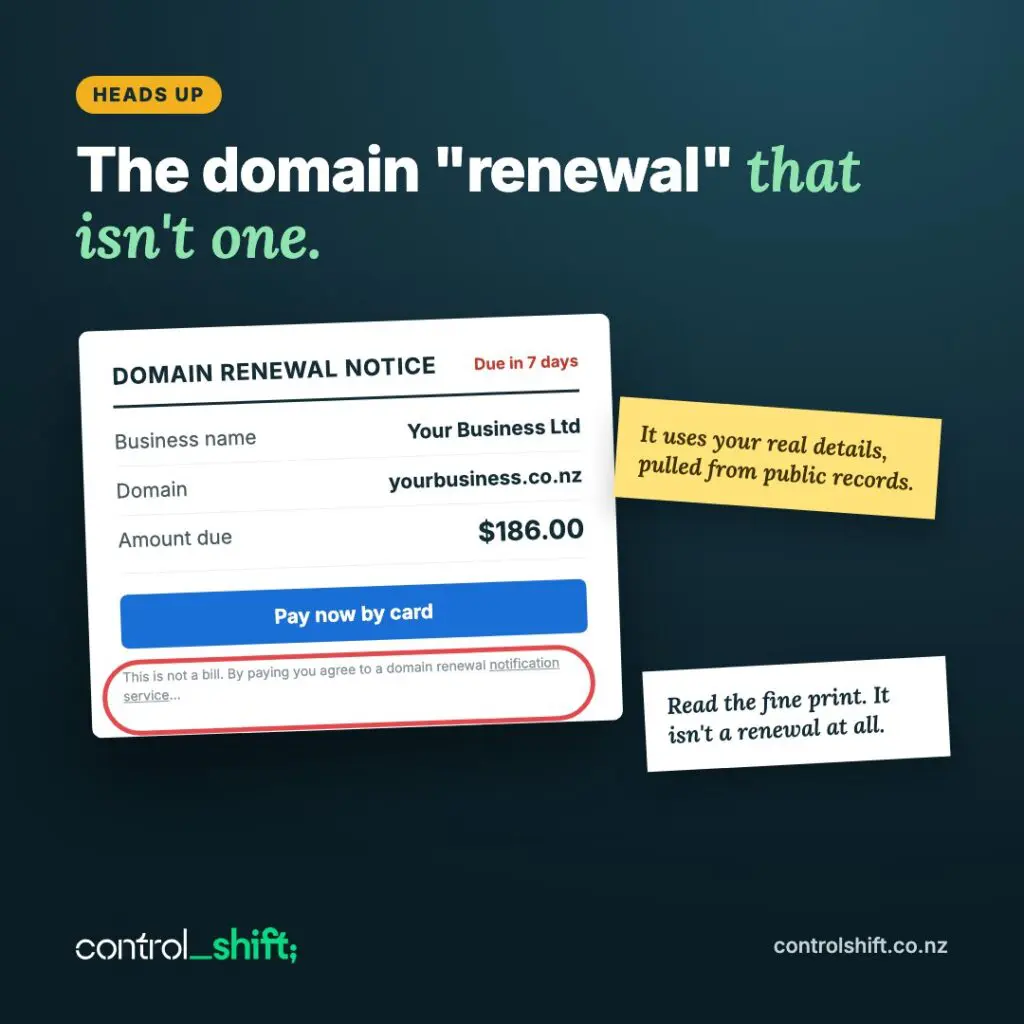
The catch is in the fine print
It isn’t a renewal at all. Paying signs you up to a “renewal notification service” you don’t need, at a price well above a normal renewal. Your domain doesn’t renew any sooner.
Signs it's a fake
- It’s from a company you’ve never dealt with.
- There’s urgency: a short deadline and a “pay now by card” button.
- The fine print doesn’t match the headline.
- It arrives by post or email out of the blue, rather than from whoever you normally pay.
What to do
- Don’t pay it, and don’t click any links in it.
- If we manage your domain, renewals come through our normal invoice, never a surprise card payment request.
- Not sure? Forward it to us before you pay anything.
- Already paid? Contact your bank straight away.
Another one to watch: fake "I'm not a robot" checks
Some hacked websites show a fake human check that asks you to press Windows + R and paste something, or open Terminal on a Mac. No real website will ever ask you to do that to prove you’re human. If one does, close the tab.